The Curator’s Flat
The Curator is taller than I expect. People are often surprised when they meet me for the first time, because they don’t expect me to loom over them. As I shake his hands and look up at him, I think “ah I get it”.
We’re in his flat at Keeling House, built in 1954 by the English architect Denys Lasdun. It’s one of those “design buildings”, an experiment in socialist, modernist architecture. The flats are distanced from the service area, and the outward-facing balconies don’t look at one another. The towers are arranged so everyone feels the sun during the day.
The Curator also owns a barge outside of London, and he’s headed over in a few days, after spending some time with his mom. He’s procrastinating the trip because, with the heat wave, “the barge is like a tin foil”. I make a joke about not wanting to get cooked.
I’m renting The Curator’s flat for two weeks, and I’ve been excited since I found it on AirBnB. As if by compulsion, I passed on flat after flat, waiting to find the perfect one, and eventually I did. And as soon as I got Mark’s message saying “I haven’t rented this flat out in a while and I’d like to know who you are”, I knew this was the one.
The Curator (of contemporary art) has travelled much in his job, but not to India or Africa. He hopes to change that in the next decade. Particularly he wants to visit Lagos. I excitedly describe the active explosion of Nigerian culture ignited by music, technology, the internet, and global publishing. He compares it to London in the 60s.
After we catch up, The Curator gives me a tour. The flat is decorated with pops of colour and lots of light. Every object is intentional, and beautiful. There are tons of art, philosophy and gardening books. There are sculptures and paintings carefully placed everywhere. The kitchen is fully stocked and functional. The room feels like a room, the study like a study, the living area like a living area. The flat feels like an exhibition, and The Curator is the artist.
Keeling House, now a luxury property owned by a private developer, was originally designed as social housing. This is one of the reasons why The Curator loves this flat: it reminds him of a time when beautiful things were made for everyone.
I ask him what makes a good curator. He says you need a passion for communication. Okay, but what makes a good curator different from a good copywriter? He says you have to understand space and arrangement. He pauses for a while and then adds that you also need a conviction. I ask about his conviction. He simply says “socialism”.
Before he leaves, The Curator recommends I meet the concierge, Graham. And so I do. Before I leave, I get to know Graham, and I find out he’s a painter. I look up his Instagram, and I find something I really like — a pop-art rendition of a large rooster, one in a series of paintings about the Chinese New Year, birthed in isolation during the lockdown.
You see, there’s also a large rooster in The Curator’s flat. As you enter the staircase, a big black sculpture sits cocky on the window sill. Graham’s painting would be my way of carrying this little slice of heaven back home, so I take it with me, first to Lagos, and then to Nairobi.
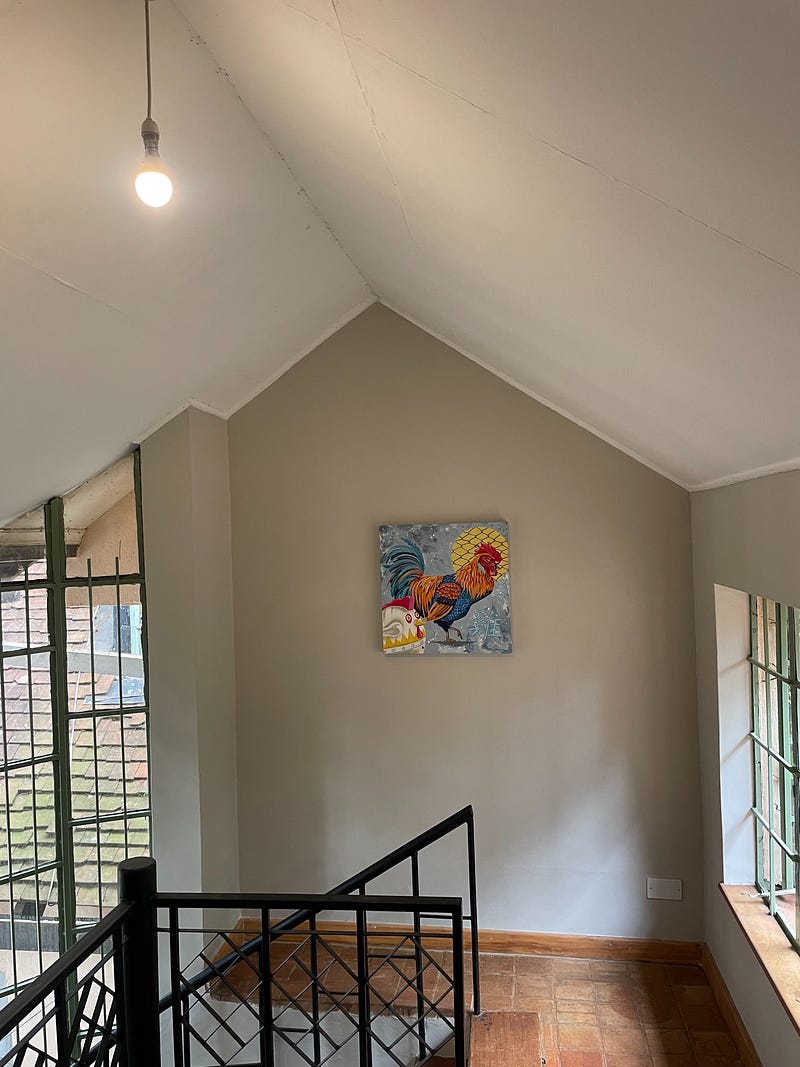
I promise to send a picture when I hang up the painting, and two months later, I get to fulfil my promise. I send Graham a photo, and he responds “Omg !! The wall colour makes it pop !! 🙏🏼😉😁”.
Graham’s Year of the Rooster, a memento of The Curator’s flat, now hangs outside my apartment. It reminds me of many things: London, Keeling House, Mark, Graham, Flat 27, Tom (the cock), my friends visiting the house, and me excitedly showing them around.
Most importantly though, it reminds me that a different life is possible.
A different life is possible.